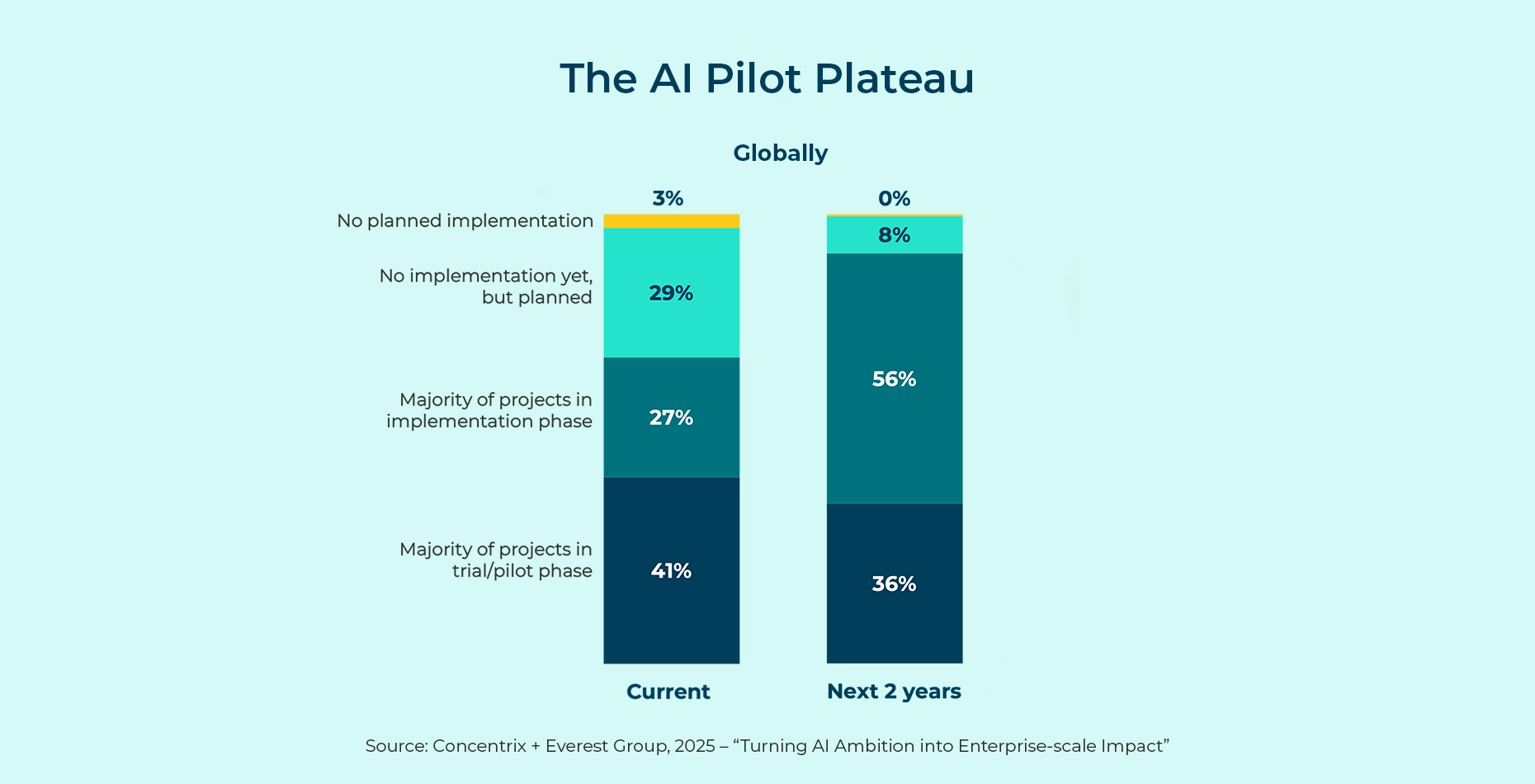
The global AI boom has fueled a rush of experimentation. Across industries, enterprises are launching generative AI (GenAI) pilots at record speed—yet most remain stuck in what Concentrix and Everest Group call the “pilot plateau.”
In a 2025 study of more than 450 enterprises worldwide, we found that:
Despite the investment and intent, the results show that scaling AI pilots requires far more than technical experimentation.
According to Concentrix and Everest Group’s analysis, the same friction points appear across every sector and geography. These are structural barriers.
| Top Barrier | % of Enterprises Affected | What It Means |
| Lack of AI skills and expertise | 56% | Shortage of prompt engineers, MLOps specialists, and product owners |
| Cybersecurity & model risk | 51% | Data protection fears delay production rollout |
| Data integrity & bias | 47% | Poor data lineage and labeling limit trustworthy AI |
| Legacy integration challenges | 41% | Old IT architectures block AI deployment |
| Infrastructure complexity | 34% | GPU constraints, cloud costs, operational drag |

Scaling AI will demand more of businesses than just more AI pilots. Repeatability, governance, and ROI-driven execution are becoming the hallmarks of successful enterprise-wide adoption.
Concentrix and Everest Group have outlined a five-step framework that separates leaders from laggards:

More than 80% of enterprises plan to increase their AI budgets over the next two years. Yet budget growth doesn’t always translate to business growth. Without early wins, the C-suite stays cautious—approving only low-risk, short-term projects like copilots or chat summarization bots that demonstrate quick value but rarely move the enterprise forward.
This pattern exposes a deeper issue: AI scale is constrained by readiness. Enterprises often underestimate the capital discipline, governance maturity, and organizational change required to move from prototype to production.
At the same time, the research highlights a critical strategic pivot. 63% percent of organizations now favor a hybrid model—combining in-house development with external partnerships—to accelerate scale and reduce execution risk.
This approach reflects a more pragmatic understanding of what it takes to operationalize AI: no single enterprise can master every layer of infrastructure, compliance, and skills in isolation.
AI has become about building the institutional capacity to manage intelligence as a living system—one that spans people, data, and processes. For organizations at this crossroads, the takeaway is clear: scaling requires both economic discipline and ecosystem thinking. Enterprises that align funding, governance, and collaboration models stand the best chance of turning AI pilots into performance.
The era of endless AI pilots is over. Our research with Everest Group confirms it: scaling AI is now the true measure of enterprise maturity.
At Concentrix, we help organizations move from proof of concept to proof of performance—embedding AI where it matters most: in the hands of people, in the flow of work, and in the core of your business.